Logistics Network

From Production to Delivery — Continuous Shipment Discipline

Logistics is not a separate step from production; it is a process planned through shipment flow, document set and lead-time visibility.

Logistics Network
Scroll Down
One Language

The Right-Delivery Triangle

When production ends, the work does not. The critical moment is when delivery flows in the right format, to the right address, at the right time. Logistics speaking the same language as production rests on these three axes.

Right Format

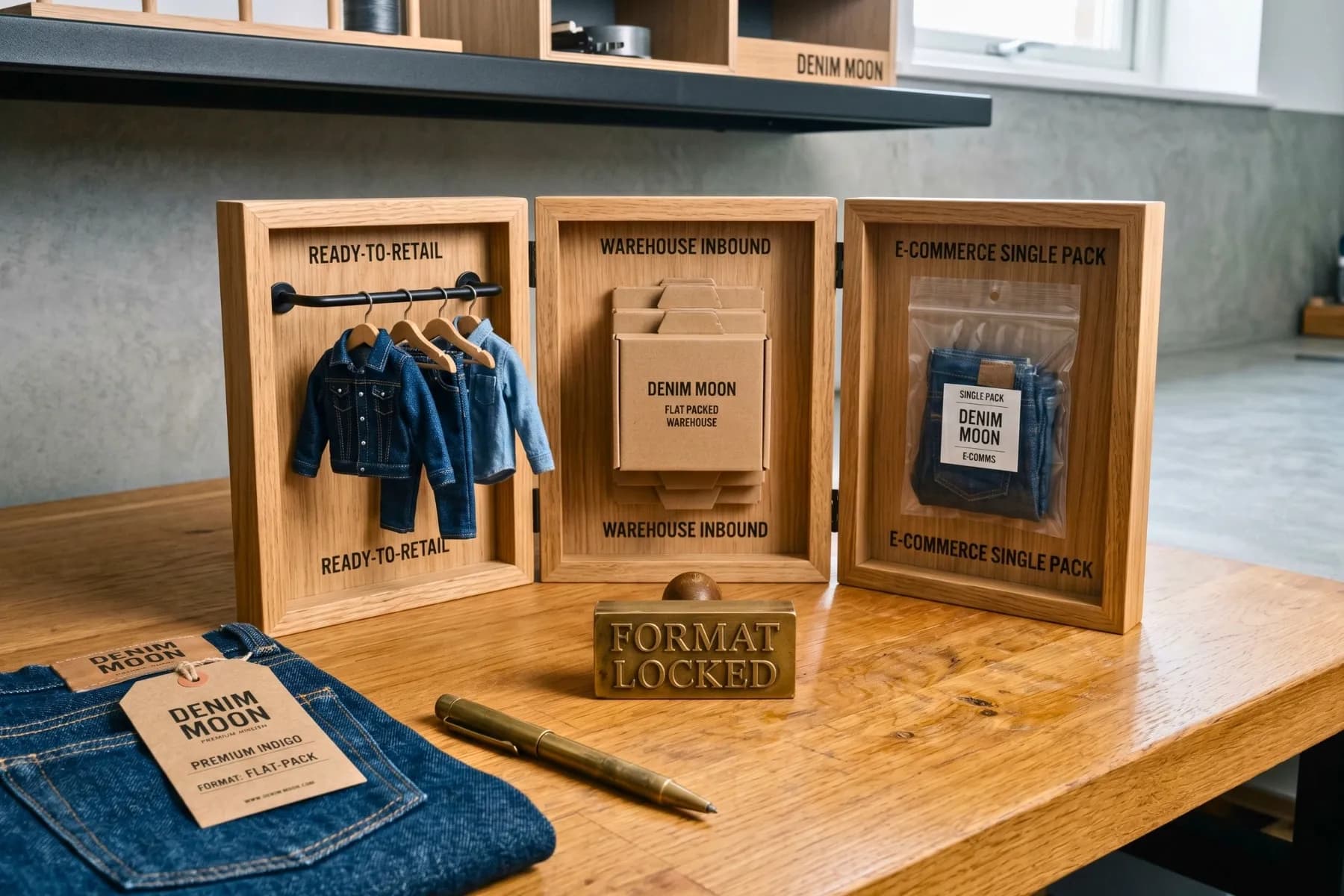
Delivery format is set before production begins. Hung, folded, boxed or bagged is decided by the buyer channel; RTR for retail, polybag for e-commerce, palette for the DC. If format is not closed up front, last-minute repacking cost stacks onto the line.

Close the format decision in writing before the contract; if the buyer channel changes the format reopens, and last-minute instructions do not drop on the line.

Right Address

An address is not only the destination; it carries the acceptance standard of the buyer type — store, warehouse or 3PL. Each warehouse applies its own rules on barcode, carton size and ASN format. If the address is not locked, the shipment waits at receiving.

Lock buyer acceptance standards in writing on the first order; barcode, carton and ASN requirements become part of the contract, and no surprise hits at receiving.

Right Time

Delivery time must match the season calendar, campaign start and store opening. A production calendar that counts back from the launch date also opens room for partial shipment scenarios. A plan locked into a single date misses the whole chain on a small slip.

Count down from the launch date; production, shipment and customs windows are spaced with buffer inside the total schedule, not stacked at the end.

Pre-Order Frame

Logistics Design

Logistics is not post-production transport but a delivery standard designed at order start. An unclear format produces cost and delay on the floor. When delivery is defined up front, friction lives in the plan, not the operation itself.

Set Up Front

Format Definition

Delivery format is defined before production starts: hung, folded, boxed, bagged. If the decision is not closed up front, last-minute repacking cost stacks on production; RTR for retail, polybag for e-commerce, palette for the DC.

Local Match

Labelling Standard

Barcode placement, price tag format and country-specific requirements are set up front. Care label, country of origin and barcode shift by destination market; the EU, US and UK apply their own standard, the file is locked at season start.

Carton or Pallet

Shipment Unit

Shipment runs as carton, pallet or mixed; the decision is shaped by the buyer's receiving process. If the store takes loose cartons a pallet is redundant; if the DC expects pallets cartons are not loaded loose. Unit choice hits cost.

Volume Yield

Carton Layout

In-carton layout is designed to support volume efficiency: size sequence, colour grouping and product ratio. Empty volume is the hidden line of freight cost; a SKU-based layout reduces carton count and raises fill rate on truck or vessel.

Twin Track

In Sync with Production

When logistics design runs in sync with the production calendar, last-minute revisions drop. Format, label and shipment plan move as a parallel track, not a separate one; the matched rhythm prevents cascading delay across the customs chain.

Shelf-Ready

Store-Based Pre-Pack

The carton is prepared to land on a single store's shelf without re-sorting at the DC. Size and colour break is set per store; labels, hangers and price tags arrive attached, the store team opens the box and places items on the shelf.

Frictionless Receipt

Warehouse & DC Alignment

Every warehouse and distribution centre (DC) has its own receiving conditions. A mismatch extends delivery time and creates extra handling cost. The goal is to deliver in the correct format the first time, without rework at receiving.

Size & Weight

Size & Weight

Carton dimensions and weight limits are set to the buyer's DC receiving standard. Maximum carton weight is usually held at the 15-20 kg threshold; manual handling regulations set this limit for floor staff. Wrong size or excess weight is rejected at the receiving gate, and repacking cost stacks onto production while the schedule slips a day.

DC Standard
Barcode Match

Barcode Match

Barcode and SKU match is validated against the buyer's warehouse management system (WMS). Which standard applies — EAN-13, GTIN-14, GS1-128 — is set at season start, before the first print run. A barcode the WMS cannot read holds at receiving; a single wrong SKU stops the entire batch and stretches the manual verification window.

WMS Sync
ASN Notice

ASN Notice

If the buyer requires it, the Advance Shipping Notice (ASN) format is set in advance. Sent over EDI 856 or XML, this file uploads the shipment's carton and SKU detail to the system before arrival. A correct ASN cuts scanning time from hours to minutes; a missing one turns the load into a manual count and ties up labour.

Early Signal
Pallet Configuration

Pallet Configuration

Pallet height, wrapping and stacking standard are set on the receiving warehouse's physical conditions. EUR-pallet (1200×800), CHEP or US-pallet sizes fit different rack structures and change forklift radius. Stretch-wrap turns, corner protectors and label visibility directly affect operator speed and damage rate on the floor.

Physical Fit
Reference Building

Reference Building

The DC alignment work done on the first shipment forms a lasting reference for future deliveries. Which carton size, label language and pallet height was accepted — all logged in writing. Reorders are produced against this reference from the start; the buyer does not repeat the alignment work, and the first-batch data carries to the next.

Repeatable Set
Delivery Window

Delivery Window

Most DCs apply time-slot booking discipline for delivery. The window reserved before shipment lets the truck avoid dock waiting and helps the warehouse schedule labour for the day. If the window is missed, demurrage charges apply and the delivery is queued; the right slot also lowers freight cost and eases operations overall.

Slot Discipline
Three Separate Rhythms

Channel-Based Shipment

A single shipment approach produces errors in a multi-channel setup. RTR (Ready-to-Retail) is the 'shelf-ready' logic for the retail channel; e-commerce and marketplace are managed by acceptance standards and flow speed.

Retail

Products arrive ready-to-shelf (Ready-to-Retail). The format that does not strain store operations comes first.

  • Hung or folded, price tag attached
  • Carton count and size break by store type
  • Packaging standard fit for shelf display

E-Commerce

Format focused on individual packaging and fast distribution; warehouse outbound speed comes first.

  • Individual polybag and EAN barcoding
  • Quickly sortable in-carton layout
  • Return label and carrier compatibility

Marketplace / DC

Requires compliance with platform acceptance standards and platform-specific labelling and packing formats.

  • Platform-specific barcodes and identifiers
  • Carton layout fit for DC acceptance
  • Fulfillment centre requirement compliance
Operations Frame

Packaging Standard

Polybag, carton, label and seal — each unit drops on the line in one fixed sequence. Bag micron, carton size, ASN link and tamper trace run on a single standard across seasons. Not error — traceable receipt; sample and run end on one sheet.

Polybag Type

Polybag Type

LDPE polybag micron is set by size band; tee 30 micron, denim jacket 40-50 micron, heavy parka 60 micron. Self-seal adhesive strip, vent hole and suffocation warning print apply as one rule. Clear or printed type follows channel scheme; hanger pack and flat pack run on separate lists. Single-spec mix-ups push count errors forward to receipt.

By Category
In-Carton Layout

In-Carton Layout

Inner master-carton layout — color after color, size after size — is locked with one ratio card. Per-carton count, top-bottom split and assortment order follow the pre-pack scheme. Kraft tissue, silica gel and moisture barrier carry a 30+ day sea container without color transfer, mildew or season odor at the receipt point.

Size Order
Outer Label

Outer Label

Outer label carries GS1-128 SSCC, EAN-13 item barcode and GTIN-14 carton barcode together. Shipment reference, gross-net weight, origin and season sit in a fixed field block. Orientation, read angle and label position are marked to one rule for WMS and EDI 856 scan flow; lamination is required against dust, damp and abrasion.

Scan-Ready
Damage Protection

Damage Protection

Corner reinforcement, double-wall corrugated board and forklift-aligned stack pattern cut damage risk at source. Carton voids fill with air pillow or folded kraft to stop slip. Top weight stays in 15-20 kg manual-handling band; cross-stack on the pallet and stretch wrap stop crushing. Drop-test report number sits on the sheet.

Risk Filter
Memory Carryover

Memory Carryover

An accepted packaging template locks on the brand sheet at season close. SS, AW and drop-based refresh version on the same sheet; the AQL sample, photo set and measurement table pull from that sheet. Template change runs from one hand with sign-off, leaves no waste in operator rotation; old version stays in archive 24 months.

Across Seasons
Tamper-Evident Seal

Tamper-Evident Seal

A numbered tamper-evident tape and QR-coded security seal close the carton mouth. Break trace falls to the receiver's first field check; the report ties to a photo on the spot. Seal number tracks on the ASN, shipping note and invoice; pushes grey-market and warehouse return mix-ups forward. Sample carton seals on a separate series.

Break Trace
Complete Declaration

Documentation Set

A missing or wrong paper holds a physically ready shipment for days. Commercial invoice, packing list, origin, transport, insurance and extra papers are prepared in one folder by destination country demand. Not speed — correct receipt.

Term Band

Commercial Invoice

Item detail, HS code, unit price, total amount and payment term gather on one invoice. Incoterms (FOB, CIF, EXW, DAP, DDP) settle at order start. Liability and cost line carry to the contract; the document is first piece of export file.

Count Match

Packing List

Per-carton content detail, in-carton count, gross-net weight and volume sit on one list. The list is the core reference for customs, warehouse receipt and count checks. Wrong count triggers fast rejection; SSCC and sequence tie to the list.

Preferential Tariff

Certificate of Origin

A.TR, EUR.1, EUR-MED or Form A is issued by the destination customs requirement. Preferential tariff cuts the buyer's import cost. The wrong type stops the shipment at port; the flow runs via chamber approval and customs broker channel.

Shipping Mode

Transport Document

Bill of Lading (B/L), Airway Bill (AWB) or CMR is issued by shipping mode. Shipper, consignee, carrier, gross weight and container number lock on one document. Master and House split runs through the agent; title passes via the doc.

CIF Coverage

Cargo Insurance Policy

Under CIF and CIP terms cargo insurance is required on the buyer's behalf. Institute Cargo Clauses (A) full, (B) limited and (C) base define the risk level. Policy amount ties to the 110% CIF value standard; claim runs via document.

Country Demand

Additional Documents

Fumigation certificate, ISPM-15 pallet stamp, health declaration, REACH and OEKO-TEX reports are issued on buyer or country demand. A missing extra paper holds the shipment at port; the demand list is logged at order confirmation.

Phased Delivery

Partial Shipment

Not every order has to ship in one go. Set right, partial shipment aligns with the store opening, campaign launch and floor day. The aim is to turn split delivery into a detailed plan, not chaos; the lot list locks early.

Priority Order
01

Priority Order

What goes into the first shipment is set at the start; the store opening, the campaign launch and the channel rule shape the order. Best-seller sizes, core colors and window combo gather first; secondary items tie to the second and third lot. The call is logged on the PI and PO; supplier and buyer read from one list, the recall risk drops.

Calendar Match
02

Calendar Match

Partial shipment volume matches the store opening, season floor day or campaign launch date. The line's weekly output adds to the transit time; sea 25-30 days, air 4-6 days, road 8-12 days enter the math. Port shifts, the customs calendar and public holidays are scanned upfront; late-lot risk closes at the start, lost sales day is avoided.

Paperwork Split
03

Paperwork Split

A separate documentation set is prepared for each partial shipment; commercial invoice, packing list, origin and transport document are issued by lot. Total order tracking runs under the master PO; a trace number adds to each lot. Under L/C, lot count and amount are defined upfront; the bank approval does not retrigger, payment flow runs without break.

Cost Effect
04

Cost Effect

Splitting the shipment moves the freight cost directly; one FCL beats two partial LCLs on freight, the air share drops. Demurrage, detention and warehouse holding cost add to the lot. Express air shipping pushes the unit freight three-four times; an early call avoids the heavy air share, margin is kept and the decision runs transparent end to end.

Plan Progress
05

Plan Progress

The partial shipment plan refreshes by line progress, fabric arrival time and the quality sign-off status. A lot off the line slides to the next shipment; the AQL-pending lot stays in quarantine. The current plan goes to the buyer in a weekly progress report; the revised calendar logs as PI and PO appendix, the buyer reads from one channel.

Contract Clause
06

Contract Clause

The right to partial shipment is written clearly in the order confirmation and the L/C text; UCP 600 article 31 'partial shipment allowed' or 'not allowed' option is selected. Bank discount is set per lot; buyer payment ties to each lot's invoice. Late-lot penalty and final shipping date stand on a numeric line; dispute does not move to arbitration.

Calm Coordination

Communication & Escalation

In logistics, problems can happen; what matters is how fast and how clearly they are managed. Single contact, rhythmic update, escalation threshold and three-part format bring data and options. Not crisis — controlled

Direct Line

Single Point of Contact

A single contact is assigned to the buyer side; order, production, quality and customs queries pass through one person. Backup is named, off-hours and holidays defined. The decision chain runs under one signature; data does not fragment.

Fixed Rhythm

Status Update

Status update is shared at fixed intervals through production, pre-dispatch, departure, transit and port stages. Checkpoint format gathers planned time, actual time and deviation note in three columns. The buyer never asks 'where are we'.

Manager Limit

Escalation Threshold

Who solves which delay locks on a table at the start. A 24-hour deviation goes to the ops manager, 48 hours to the production director, 72 hours to the general manager. Threshold breach triggers an automatic alert; late-news risk drops.

Three-Part Format

Clear Briefing

A problem brief comes in three parts: 'what the issue is, what options exist, how the calendar may shift.' Extra cost and time sit in a side column for each. The buyer decides on a numeric base, not emotional one; response time shortens.

Alternative Port

Backup Route

A backup port, an alternative road route and air cargo pricing are prepared at the start. Tekirdağ or Gemlik replaces Istanbul-Ambarlı; for Europe, the Austria-Germany road lane stays optional. When trouble hits, day-level loss is avoided.

Lessons Note

Post-Shipment Review

After every shipment a short review meeting takes place. Plan vs actual deviation, root cause, the action taken and an improvement note for the next shipment go on record. Supplier and buyer keep one file; repeating mistakes are cut.

Right Minimum

Shipment Initiation Process

To start, you need the right minimum inputs, not a 'perfect system.' The first shipment plan locks the channel, format, packaging, paperwork, deadline and responsibility map in six clear steps. Not error, controlled launch.

Channel & Buyer
01

Channel & Buyer

Which channel and buyer type the first shipment goes to is set at the start. Store, e-commerce warehouse, 3PL or DC; each type has its own receipt hours, label language, intake procedure and dock booking rule. Single-store pre-pack and DC pallet-based layout gather on one sheet; channel rule carries to the contract, friction drops upfront.

Delivery Format
02

Delivery Format

Whether the delivery type is RTR (Ready-to-Retail) or warehouse intake (inbound) is defined upfront. Each channel asks for its own format; store hanger pack, DC flat pack, e-commerce single-pack. The format decision moves the packaging template, label set and cost line directly; mixed format adds handling time, count errors and shrinkage.

Packaging & Labeling
03

Packaging & Labeling

Carton layout, label language, barcode format and split logic lock at the season start. EAN-13 item, GS1-128 SSCC carton, GTIN-14 outer carton, size-color ratio card and the top-bottom order gather on one sheet. Label language is set by the target buyer market — TR, EN, DE, FR; barcode position, read angle and lamination fit the WMS flow.

Export File
04

Export File

Shipping papers and customs documents gather in one file; Incoterms (FOB, CIF, EXW, DAP, DDP) move to written form at order confirmation. Commercial invoice, packing list, origin (A.TR, EUR.1, Form A), transport doc, insurance policy and on-demand extra papers are issued by lot. Letter of Credit (L/C) and bank discount tie to the file flow.

Deadline Window
05

Deadline Window

The delivery window, critical dates and the partial shipment need are set on the PI and PO at the start. Store opening, season floor day or the campaign launch date shapes the window. Line dispatch day adds to the transit time (sea 25-30, air 4-6, road 8-12 days); late-lot penalty and final shipping date stand on a numeric contract line item.

Responsibility Map
06

Responsibility Map

Owners, approval points and the escalation path settle on the RACI table. Order owner, production, quality, customs broker, bank and freight forwarder gather in one matrix. The approval chain ties to the 24-48-72 hour deviation step; the single contact (SPOC) runs on the same channel with the buyer side throughout the order period and file.

Written Plan in 30 Minutes

What the Meeting Promises

We set aside 30-45 minutes not to pitch but to settle your logistics frame together. Prep stays off your desk; you describe the current flow, we put the six backbone topics on paper and send a brief written for you after the meeting.

30-45 Minutes

Fixed Agenda

The meeting runs 30-45 minutes; a fixed agenda for start, middle and close goes ahead. The first ten minutes are short channel and format listening, the middle twenty minutes a risk scan, the last ten drawing the starter brief together.

Tell Us Your Flow

No Prep Needed

No need to prepare any document or set up screen sharing before the meeting. You describe your current supplier flow, buyer type and past delay points; specific questions come from us, answers go on paper together with us in real time.

In Six Lines

A Brief for You

After the meeting, a starter brief written for you is sent: channel, format, packaging-labeling, papers, deadline and responsibility map stand on six written lines. The meeting ends with a file, not in the air; non-binding, ground for your call.

Risk-Free First Step

Plan a Logistics Meeting

Let's settle your delivery format, channel-based shipment split and documentation set together in one logistics frame. The first meeting prepares a starter brief written for you that cuts the customs and label delay risk at source.

Select a form to display here.

The Floor's Live Mirror

Discover the technology side that brings planning, quality and shipment data on one screen, tracking every step in real time.

View the Technology
Denim Moon © 2026 · Powered by Dimotihe